


 Restoration Planting and Carbon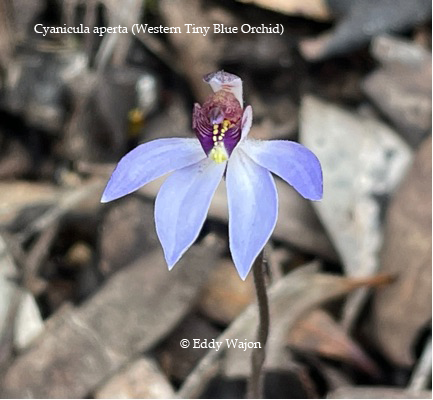
We love it when we’re proved wrong on how long revegetation takes to move towards a fully functioning ecosystem – because it is happening faster than we initially thought! We are delighted with the news, outlined in the Medial Release below from the Wildflower Society’s Eddy Wajon, that it took only 17 years for orchids to start appearing in the revegetation undertaken on Chingarrup Sanctuary, the first property purchased for conservation in the Gondwana Link ecological pathway (Fitz-Stirling section). And malleefowl!
(The images are also from Eddy)
Media Release from Eddy and Donna is below:
“FIRST NATIVE ORCHIDS FOUND IN REVEGETATION
26 October 2025
The first native orchids have been found in revegetation undertaken as part of Gondwana Link, an ambitious project to re-connect the bush from Margaret River to east of Kalgoorlie.
At the Biodiversity Conference being held in the University Club at the University of Western Australia from 28 to 30 October 2025, Dr Eddy Wajon, co-owner of Chingarrup Sanctuary, will announce that 6 native orchid species had been observed in revegetation 17-21 years after planting.
This should be compared with the prediction made by Keith Bradby, CEO of Gondwana Link Ltd, that it would probably take 40-50 years for native orchids to be observed in revegetation undertaken in the Great Southern Wheatbelt.
The six orchid species included one individual of Cyanicula aperta (Western Tiny Blue Orchid) which was found in 2022, 17 years after revegetation, and again in 2023, in vegetation planted in 2005 from seed which did not include orchid seed.
Then in early October 2025, significant numbers of 5 orchid species (Caladenia barbarossa (Common Dragon Orchid), Caladenia doutchiae (Purple-veined Spider Orchid), Caladenia falcata (Fringed Mantis Orchid), Pterostylis picta (Painted Rufous Greenhood) and Pterostylis perculta were found in vegetation planted in 2004, 21 years after revegetation from seed which did not include orchid seed.
From 2011, Eddy Wajon and his wife, who live in Perth, started undertaking a wide variety of fox, cat and weed control with the help of Bush Heritage Australia (BHA). Prior to feral animal control, they rarely saw Malleefowl, but once they started baiting, they saw Malleefowl regularly, despite the fact that there was little evidence of foxes or cats taking baits. Now, they see Malleefowl on every 4 to 6-weekly visit.
Then, in 2017, they found 2 Malleefowl mounds in vegetation planted in 2005, 12 years after planting. There are now 7 active Malleefowl mounds, three in revegetated areas. Extensive remote camera monitoring has shown that Malleefowl have laid eggs and chicks have hatched.
This is so exciting and evidence (along with bird, mammal, reptile and vegetation monitoring) that revegetation is bringing back habitat for a range of species and restoring ecological functioning. Though there are still feral animals and weeds on the property, Eddy and Donna have made a significant contribution to the protection and restoration of some of WA’s international Biodiversity Hotspot.
Eddy Wajon and his wife were the first buyers in Gondwana Link. They bought 2 properties, Chingarrup Sanctuary, a 572 ha property in Boxwood Hill, and Mondurup View, a 46ha property in Tenterden, on opposite sides of the Stirling Ranges, for the same price, on the same day (23 December 2002) solely for conservation.
Most of Chingarrup Sanctuary was cleared in the 1970s and 1980s. When Eddy and Donna bought it, all but 100ha had regrown. With the help of BHA, Greening Australia and Shell Reconnections, about 90 ha of that 100 ha was revegetated in 2004, 2005 and 2007 from seed of 50 different species, mostly Acacias, Melaleucas, Eucalypts, Sheoaks, Callistemons and Calothamnus. About 95% of that revegetation has survived.
Flora and fauna surveys have found 670 native flora species and 950 native fauna species on the property.”
